Summary:
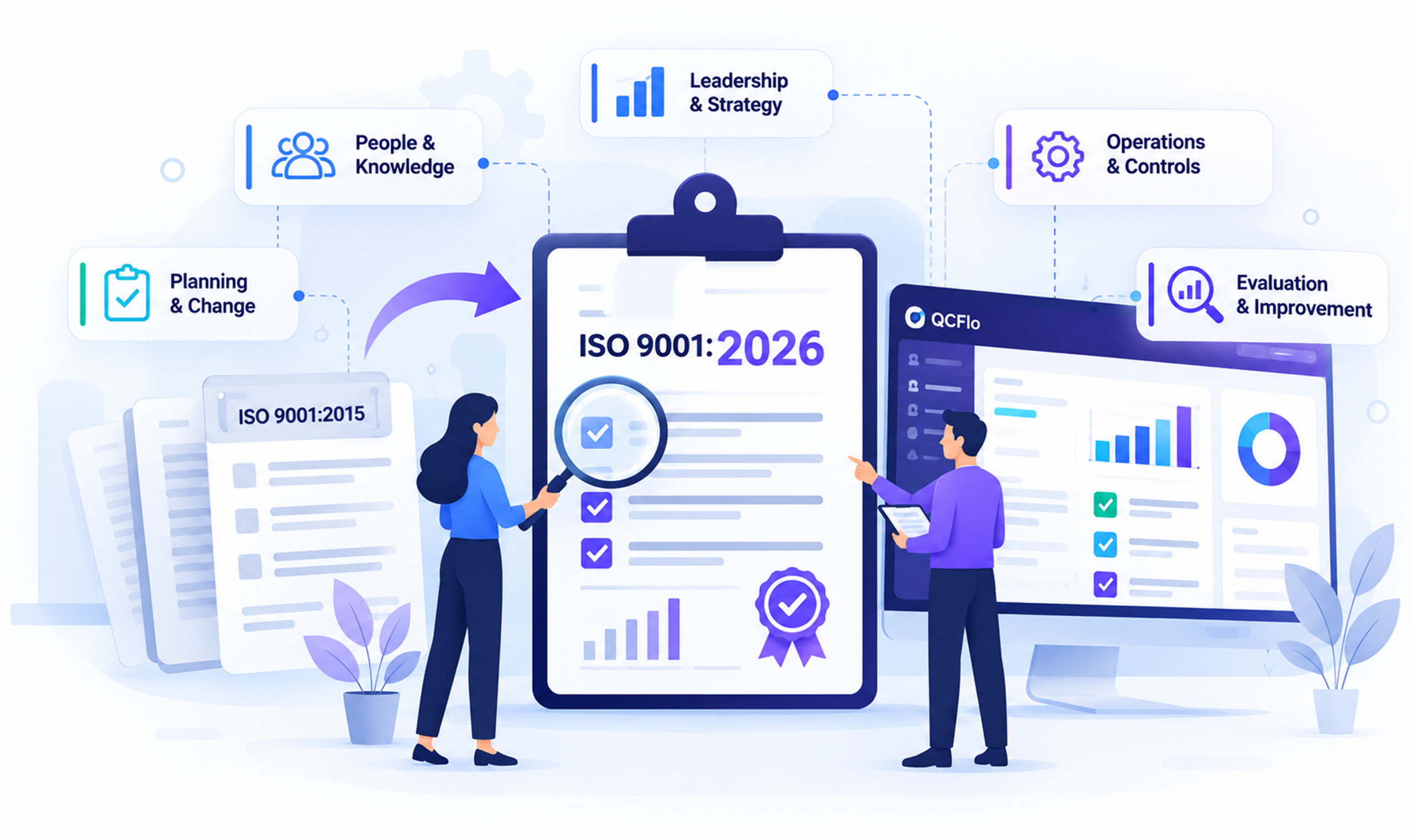
The ISO 9001:2026 transition raises practical questions about what organizations need to change, what can remain in place, and how to prepare effectively. This blog explains the key changes, their implications for existing QMSs, transition timelines, common mistakes, and when the transition may justify broader QMS improvements.
ISO 9001:2026 replaces the 2015 edition, but the revision is not simply a list of new requirements. The 2026 edition retains the familiar ISO 9001 framework while placing greater emphasis on leadership and quality culture, strategic alignment, risks and opportunities, people, and clearer interpretation through Annex A.
For organizations with an established QMS, the more important question is how these changes affect existing processes, controls, and evidence. The transition therefore calls for a closer look at how these elements work together within the QMS, rather than a simple checklist of revised clauses. This article examines the key changes, what remains familiar, and what organizations should assess in their existing QMS as they plan the transition.
ISO 9001:2026 Changes: What Actually Changed?
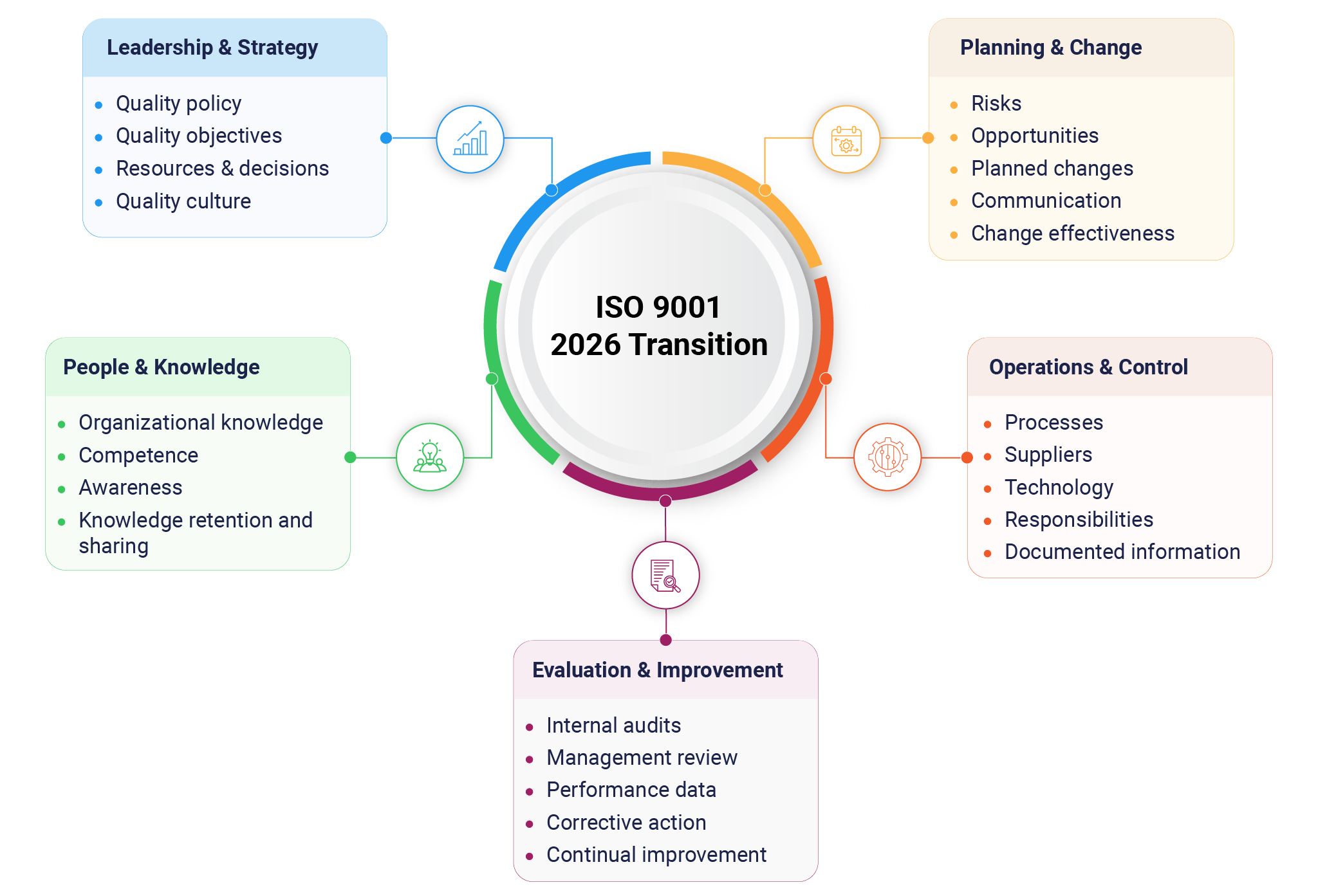
ISO 9001:2026 strengthens the connection between the QMS and how an organization is led, planned, changed, and improved. The most significant changes concern quality culture and ethical behavior, strategic alignment, separate treatment of risks and opportunities, planned change, organizational knowledge and awareness, and organizational context.
- Leadership, quality culture, and ethical behavior (Clause 5.1.1): Top management has an explicit role in promoting quality culture and ethical behavior.
- Strategic alignment (Clause 5.2): The quality policy is more clearly linked to organizational context and strategic direction.
- Risks and opportunities (Clauses 6.1.2 and 6.1.3): Actions addressing risks are separated from actions to pursue opportunities.
- Planned change (Clause 6.3): Change management places greater emphasis on communication, monitoring, evaluation, and review.
- Knowledge and awareness (Clauses 7.1.6 and 7.3): Greater emphasis is placed on sharing organizational knowledge and awareness of quality culture and ethical behavior.
- Context and climate (Clauses 4.1 and 4.2): The climate-change consideration introduced through the 2024 amendment is carried into the 2026 standard.
- Annexes: Annex A has been expanded to clarify structure, terminology, and intent without adding requirements, while Annex B has been removed.
What Stayed the Same in ISO 9001:2026?
ISO 9001:2026 retains the core structure and operating principles of ISO 9001:2015. Organizations with an established quality management system will therefore recognize much of the underlying approach.
Several fundamentals remain unchanged:
- Customer focus remains central (Clause 5.1.2): Organizations continue to determine and meet customer requirements and enhance customer satisfaction.
- The process approach remains fundamental: The QMS continues to be managed as a system of interconnected processes.
- PDCA remains embedded: Plan-Do-Check-Act continues to underpin QMS planning, operation, evaluation, and improvement.
- Continual improvement remains essential (Clause 10.1): Organizations continue to improve the suitability, adequacy, and effectiveness of the QMS.
For a quick view of what remains familiar and where the 2026 edition places greater emphasis:
| QMS Area | What Stays Familiar | What Deserves Attention in 2026 |
|---|---|---|
| Leadership | Leadership remains responsible for QMS effectiveness | Quality culture and ethical behavior |
| Risk and opportunity | Risk-based thinking remains part of QMS planning | Clearer treatment of opportunities |
| Change management | Changes continue to be planned and controlled | Effects and effectiveness of planned change |
| People and knowledge | Competence and awareness remain QMS requirements | Organizational knowledge and quality culture |
| Context | Organizations continue to determine relevant internal and external issues | Climate change where relevant |
What Do the 2026 Changes Mean for an Existing QMS?
For an organization with an established ISO 9001 QMS, the 2026 revision is less about rebuilding the system and more about examining how well the existing QMS supports leadership decisions, risks and opportunities, planned change, organizational knowledge, and continual improvement.
The practical impact will depend on how the QMS currently operates. A mature system may already address many of the revised expectations, while a QMS that relies heavily on isolated procedures, manual records, or individual knowledge may require more substantial changes.
1. Leadership and strategic alignment
The revised requirements make the connection between quality management and organizational direction more visible. Organizations should examine how quality objectives, the quality policy, performance results, risks, opportunities, and improvement priorities influence leadership decisions.
The focus is not necessarily on rewriting the quality policy. It is demonstrated that quality considerations influence priorities, resources, decisions, and actions. The greater emphasis on quality culture and ethical behavior also means looking at how leadership expectations are communicated and how quality or ethical concerns are raised and addressed.
2. Risks, opportunities, and planned change
The 2026 revision provides clearer treatment of risks and opportunities, so existing processes should be reviewed to determine whether both are actively addressed and evaluated.
Planned change should also be treated as more than a documentation exercise. Changes to people, processes, technology, suppliers, facilities, or responsibilities can affect QMS performance across multiple areas. Existing change control workflows should therefore consider potential effects, communication, monitoring, and whether the change achieved its intended result.
3. Organizational knowledge, competence, and awareness
The stronger focus on organizational knowledge requires organizations to identify what knowledge is critical to QMS performance, where it resides, and how it is retained and shared. This is particularly relevant when important process knowledge depends heavily on individual employees or subject-matter experts.
Awareness also extends beyond knowing procedures. Employees should understand how their work contributes to quality and how quality culture and ethical behavior apply to their day-to-day decisions.
4. Organizational context and climate considerations
The 2026 standard carries forward the climate-change consideration introduced through the 2024 amendment. Organizations should determine whether climate change is relevant to their ability to achieve intended QMS results.
Where relevant, climate-related factors may need to be reflected in existing context, interested-party, risk, or planning processes. This does not mean creating a separate environmental program.
5. Audits, management review, and continual improvement
Internal QMS audits and management reviews should help determine whether revised practices are implemented effectively and producing the intended results. This is especially important for areas such as quality culture, opportunities, organizational knowledge, and management of change, where effectiveness may not be demonstrated by a single document or record.
The impact of ISO 9001:2026 will therefore not be measured by how many quality assurance procedures or forms change. It will be measured by whether the QMS can demonstrate stronger connections between leadership, business direction, people, risks and opportunities, planned changes, knowledge, and quality outcomes.
The next step is to assess those connections systematically, identify genuine gaps, and make targeted changes rather than revising the QMS simply because a new edition has been published.
Download The Auditor's View of a Modern Quality Management System to understand what auditors look for when evaluating QMS effectiveness, evidence, and control.
Download the WhitepaperHow to Perform an ISO 9001:2026 QMS Impact Assessment
A useful impact assessment should compare the revised requirements with how the QMS actually operates.
- Identify the changes: Separate significant revisions from clarifications and editorial changes.
- Trace existing controls: Map each relevant change to the process, responsibility, documented information, and evidence already in place.
- Locate the gap: Determine whether the issue concerns documentation, process design, implementation, evidence, or effectiveness.
- Assess impact: Consider quality risk, business impact, affected functions, and transition timing.
- Define the response: Update processes, documentation, responsibilities, training, or controls only where the assessment shows a need.
- Verify the result: Use audits, records, quality metrics, or management review to confirm that the change is implemented and effective.
This keeps the transition focused on actual QMS performance rather than document volume.
ISO 9001:2026 Transition Timeline
ISO 9001:2026 was published on September 16, 2026. Organizations certified to ISO 9001:2015 must transition to ISO 9001:2026 by September 30, 2029. From March 31, 2028, new and initial accredited certifications may only be issued to the 2026 edition.
Organizations should confirm the applicable timetable and audit arrangements with their certification body, as transition may be completed during a scheduled surveillance or recertification audit or through a separate transition audit.
Common ISO 9001:2026 Transition Mistakes
The way an organization approaches the ISO 9001:2026 transition can be as important as the changes it identifies. Some transition approaches can create unnecessary work, hide genuine gaps, or leave issues to be discovered during the certification audit. The most common mistakes organizations should avoid include:
- Starting with clauses instead of processes: A clause-by-clause review can miss how one change affects several connected activities.
- Assuming every revision demands a change: First establish whether the current process already addresses the revised requirement effectively.
- Confusing documents with implementation: An updated procedure does not show that people are following it or that the control is effective.
- Reducing quality culture to training: Awareness sessions or revised policies alone do not establish how quality expectations influence everyday decisions.
- Leaving opportunities disconnected from planning: Risk and opportunity considerations should inform decisions and actions, not exist only as register entries.
- Missing cross-functional effects: A change can affect training, suppliers, change management, audits, corrective action, or documented information at the same time.
- Relying on outdated guidance: Transition decisions should be based on the published standard and current certification guidance.
- Waiting for the external audit to test effectiveness: Internal evaluation should establish whether revised practices work before the transition assessment.
Should You Upgrade Your QMS During the ISO 9001:2026 Transition?
The transition is a useful point to assess whether the QMS software still fits the organization, but the revised standard is not, by itself, a reason to replace the technology supporting it.
Look instead at operational friction: manual approvals, disconnected records, duplicate data entry, weak traceability, difficult audit preparation, or limited visibility across quality activities. These weaknesses matter when the QMS must provide reliable evidence, connect related processes, and support management decisions.
A QMS upgrade is justified when it addresses defined operational problems or supports a broader improvement plan. The certification deadline alone is not a sound technology strategy.
Download the QMS Buyer's Guide: Choosing the Right Fit for Your Business to evaluate QMS capabilities against your organization's operational and quality requirements.
Download the GuideMaking the ISO 9001:2026 Transition Meaningful
ISO 9001:2026 is an opportunity to examine the QMS as a working management system, not simply as controlled documentation. Understand the changes, preserve effective practices, identify genuine gaps, and strengthen the areas that matter. A meaningful transition should leave the organization with a more effective QMS that supports better control, evidence, and continual improvement beyond the certification audit.
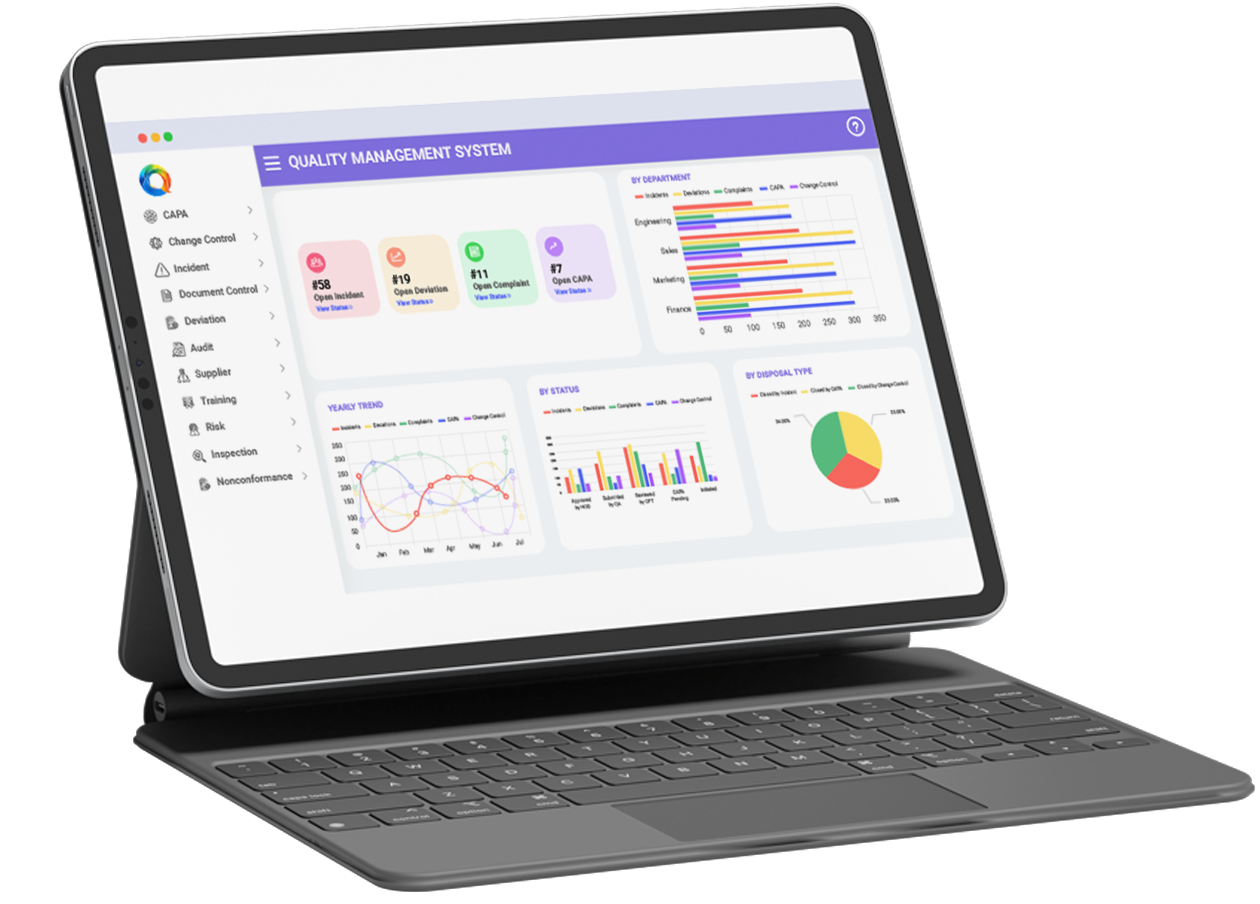
Explore QCFlo’s capabilities aligned with the 2026 changes
Book a Live DemoFAQs
-
What are the main changes in ISO 9001:2026?
ISO 9001:2026 places greater emphasis on quality culture, ethical behavior, strategic alignment, risks and opportunities, planned change, organizational knowledge, and clearer interpretation of QMS requirements.
-
What is the difference between ISO 9001:2015 and ISO 9001:2026?
ISO 9001:2026 retains the existing QMS framework but strengthens several areas, including leadership, quality culture, opportunities, change management, organizational knowledge, and consideration of climate change within organizational context.
-
Does an organization need to rebuild its QMS for ISO 9001:2026?
No. Start by assessing the current QMS against the revised requirements. If existing processes are effective, retain them and focus changes on specific gaps rather than redesigning the entire QMS system.
-
How does ISO 9001:2026 affect an existing QMS?
The impact depends on the maturity of the existing QMS. Organizations should examine leadership, planning, change management, knowledge, culture, risks and opportunities, and determine where genuine gaps exist.
-
What is the ISO 9001:2026 transition deadline?
Organizations certified to ISO 9001:2015 must transition to ISO 9001:2026 by September 30, 2029. New and initial accredited certifications will require the 2026 edition from March 31, 2028.
-
How can organizations transition from ISO 9001:2015 to ISO 9001:2026?
Start with a gap assessment, then trace affected processes, responsibilities, and evidence. Address only identified gaps, implement the changes, and verify their effectiveness before the transition assessment.
-
Does ISO 9001:2026 introduce new climate change requirements?
The 2026 edition carries forward the climate-change consideration introduced through the 2024 amendment. Organizations must determine whether climate change is relevant to their ability to achieve intended QMS results.
-
What is an ISO 9001:2026 QMS impact assessment?
A QMS impact assessment examines how the 2026 changes affect existing processes, responsibilities, controls, and evidence, helping organizations prioritize changes based on actual operational impact.
-
What are the common mistakes organizations should avoid during the ISO 9001:2026 transition?
Common mistakes include treating every revision as a required change, focusing only on documentation, overlooking cross-functional effects, relying on outdated guidance, and waiting for the external audit to identify effectiveness gaps.
-
Does an organization need to upgrade its QMS software for ISO 9001:2026?
No. The standard does not require specific QMS technology. An upgrade makes sense when existing systems create operational problems such as poor traceability, manual work, or disconnected quality records.