ISO 22000 Compliance Management with QCFlo
ISO 22000 specifies requirements for a Food Safety Management System (FSMS), helping organizations across the food chain identify food safety hazards, control risks, and ensure the safe handling of food products.
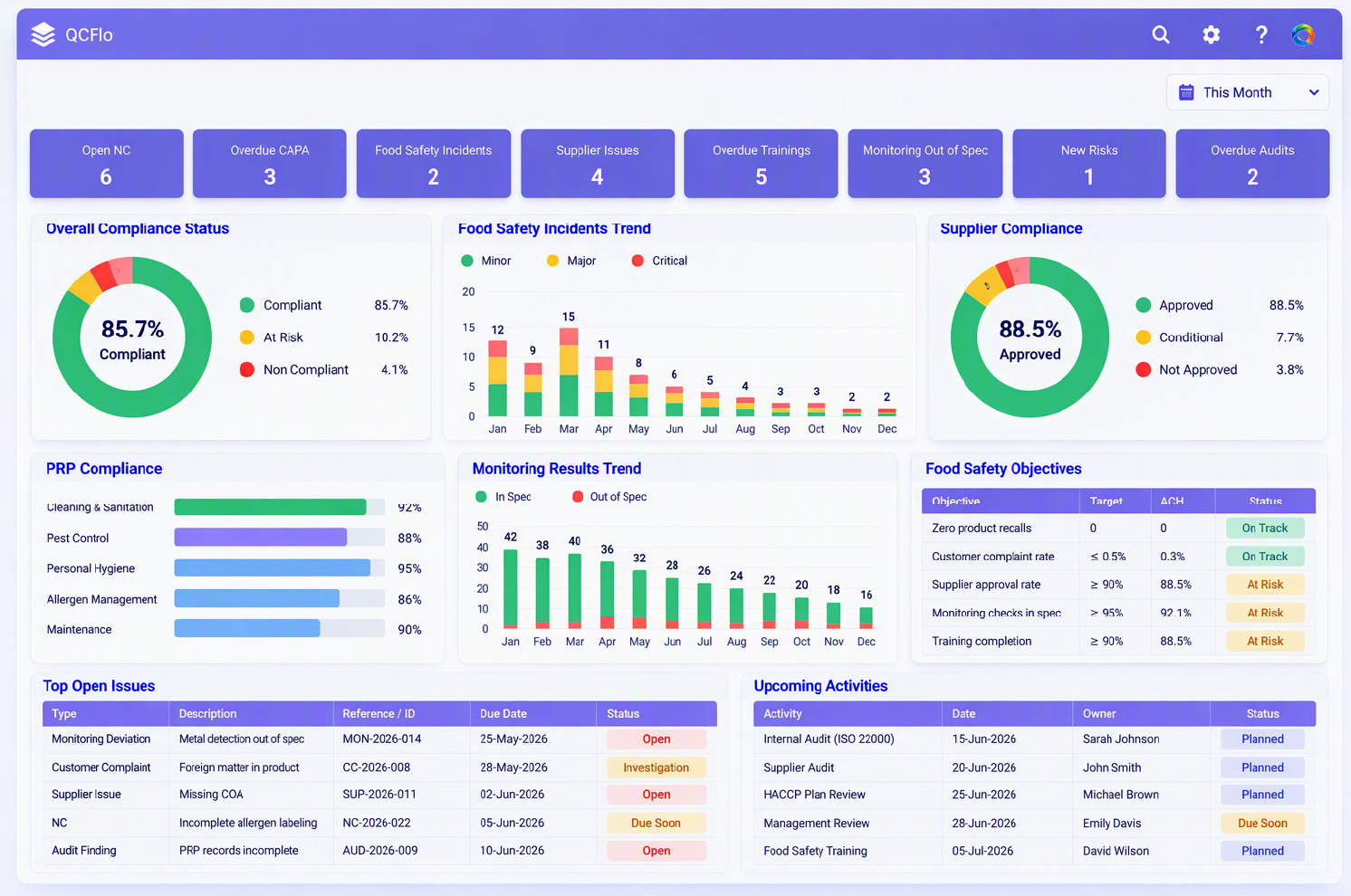
QCFlo helps food-related organizations manage controlled documentation, audits, nonconformances, corrective actions, and employee training through a centralized platform. The following compliance mapping highlights how QCFlo supports relevant ISO 22000 requirements.
| ISO 22000 Requirements | QCFlow Feature Mapping |
|---|---|
| 4.1 Organization and context - Identify internal and external issues affecting the food safety management system (FSMS), including whether climate change is relevant. | Context & Interested Parties Register and Risk Register can record business, regulatory, supply-chain and climate-related issues, impact, owner, action and review date. Management Review supports periodic review. |
| 4.2 Interested parties - Determine relevant parties and their applicable food-safety requirements, including climate-related requirements where relevant. | Interested Parties and Compliance Obligations Register can capture regulators, customers, suppliers and other parties, their requirements, evidence source, owner and review frequency. Customer complaints and supplier records provide related operational input. |
| 4.3 FSMS scope - Define boundaries, products, processes, sites and activities included in the system. | Controlled Document Library maintains the approved FSMS Scope Statement. Site, Process, Product and Location masters can define covered operations and link records to the applicable scope. |
| 4.4 FSMS - Establish, implement, maintain, update and continually improve the food safety management system. | Document Control, Training, Risk, Audit, Incident, Nonconformance, CAPA, Change Control, Objectives and Management Review collectively support the FSMS lifecycle. Food-safety-specific registers provide operational evidence. |
| 5.1 Leadership and commitment - Demonstrate active accountability for food safety and integration of FSMS requirements into business processes. | Management Review, ISO Objectives, approvals, assigned owners and dashboards provide evidence of leadership review, decisions, resources and follow-up actions. |
| 5.2 Food safety policy - Establish, communicate, maintain and make available an appropriate policy. | Controlled Document Library supports policy approval, version history, publication and review. Training/Policy Acknowledgement can distribute the policy and retain employee acknowledgement evidence. |
| 5.3 Roles, responsibilities and authorities - Assign and communicate FSMS responsibilities, including the food safety team and reporting of issues. | Person fields, role-based permissions, workflow assignments and approval matrices can define process owners, reviewers and approvers. A Food Safety Team Register can record role, competence, department and team-leader designation. |
| 6.1 Risks and opportunities - Plan actions for management-system risks and opportunities and evaluate their effectiveness. | Risk & Opportunity Register supports description, source, likelihood, impact, controls, treatment, owner, due date, status and review. Actions can link to Objectives, Change Control and CAPA. |
| 6.2 FSMS objectives and planning - Set measurable objectives and define actions, resources, owners, deadlines and evaluation. | ISO Objectives module tracks objective, KPI, baseline, target, owner, due date, progress, evidence and review status. Dashboards can show achievement and overdue actions. |
| 6.3 Planning of changes - Carry out FSMS changes in a controlled manner. | Change Control supports reason, impact/risk assessment, affected processes/documents/products, approvals, implementation actions, training, validation/verification needs and closure. |
| 7.1 Resources - Determine and provide people, infrastructure, work environment and external resources needed for the FSMS. | Training & Competence, Equipment/Asset Register, Maintenance, Supplier Management and action tracking support resource controls. Gaps or resource decisions can be recorded in Management Review. |
| 7.1.2 People - Ensure persons influencing food safety are competent and sufficient. | Training & Competence records role-based requirements, training, assessment, effectiveness and retraining. Food Safety Team Register identifies team members and competence evidence. |
| 7.1.3 Infrastructure - Provide and maintain buildings, utilities, equipment, hardware and systems needed for safe operations. | Equipment/Asset Register and Maintenance/Calibration records support identification, location, status, planned servicing and evidence. Premises/Facility Inspection can record infrastructure conditions and corrective actions. |
| 7.1.4 Work environment - Provide and maintain conditions needed to achieve food-safety requirements. | Facility Inspection, Hygiene, Cleaning & Sanitation, Pest Control and Environmental Monitoring registers can record conditions, checks, failures and actions. Incident/Deviation and CAPA address exceptions. |
| 7.1.5 Externally developed FSMS elements - Ensure externally developed processes, plans or controls are suitable and controlled. | Supplier/External Provider Management, Document Control and Change Control can record source, review, approval, current version, applicability and updates of externally developed FSMS materials. |
| 7.1.6 External providers - Define selection, evaluation, monitoring and communication controls for suppliers and contractors. | Supplier Qualification/Evaluation supports approval status, risk/category, audit, certificates, performance, issues and periodic review. Supplier NC and CAPA can manage failures and improvement. |
| 7.2 Competence - Determine competence, provide actions and retain evidence. | Training & Competence supports competency criteria, assigned learning, attendance, assessment score, effectiveness result, evidence, evaluator and retraining. |
| 7.3 Awareness - Ensure personnel understand policy, objectives, their contribution and consequences of nonconformance. | Awareness training, policy acknowledgement, toolbox talks and assessments can be managed in Training & Competence with attendance and acknowledgement evidence. |
| 7.4 Communication - Determine what, when, with whom and how to communicate internally and externally on food safety. | Communication Plan/Register can define topic, trigger, audience, channel, owner and retention of evidence. Complaints, supplier communication, alerts, recall notification and approval workflows support operational communication. |
| 7.5 Documented information - Create, update, control, protect, retain and make information available. | Controlled Document Library supports metadata, review/approval, version history, permissions, retention and search. SharePoint lists maintain structured records with Created/Modified metadata and item history. |
| 8.1 Operational planning and control - Plan, implement, control, maintain and update processes needed to meet food-safety requirements. | Process Register, SOP library, PRP Register, Hazard Analysis, Control Measure and Monitoring records support operational planning. Deviations, Change Control and CAPA manage departures and updates. |
| 8.2 Prerequisite programmes (PRPs) - Establish basic environmental and operational conditions suitable for food safety. | PRP Programme/Register should cover applicable controls such as cleaning, hygiene, pest control, water, waste, allergen control, preventive maintenance and supplier controls. Each PRP can link to SOP, owner, frequency, checklist, evidence and verification status. |
| 8.3 Traceability system - Link incoming materials, processing and distribution to enable identification and withdrawal. | Raw Material/Lot Register, Product/Recipe Master, Batch Production Record and Dispatch/Distribution Register can connect supplier lot, internal batch, finished product and consignee. Mock Recall records can test traceability effectiveness. |
| 8.4 Emergency preparedness and response - Prepare for and manage incidents that may affect food safety. | Emergency Response Plan in Document Control plus Incident Register, Emergency Drill Register, notification workflow, responsibilities, actions and post-event review support preparedness and response. |
| 8.5.1 Preliminary steps for hazard analysis - Maintain product, ingredient, intended-use, process-flow and process-environment information. | Product & Ingredient Master, Allergen Register, Intended Use/Consumer Group fields, Process Flow Register and Process Step Master provide controlled inputs. Approved process-flow diagrams can be stored in Document Control. |
| 8.5.2 Hazard analysis - Identify and assess biological, chemical, physical and allergen hazards and select suitable control measures. | Food Safety Hazard Analysis/HACCP Register should capture process step, hazard category, source, likelihood, severity, significance, existing controls, selected measure, rationale, owner and review. |
| 8.5.3 Validation of control measures - Obtain evidence that selected controls can achieve intended hazard control. | Control Measure Validation Register can capture PRP/oPRP/CCP linkage, validation method, acceptance basis, study/reference, result, approver, date and revalidation trigger. Evidence is stored in the controlled library. |
| 8.5.4 Hazard control plan - Establish and maintain operational PRPs and the HACCP plan. | oPRP & CCP Control Plan/Register can record hazard, control measure, critical/action criterion, monitoring method, frequency, responsible person, correction, corrective action, records, verification and status. |
| 8.6 Updating PRP and hazard-control information - Keep product, process, PRP and HACCP information current. | Change Control can trigger review of Product Master, Process Flow, Hazard Analysis, PRP and CCP/oPRP records. Approval and versioning retain evidence of controlled updates. |
| 8.7 Monitoring and measuring control - Ensure devices and methods are suitable, calibrated and maintained. | Calibration/Monitoring Equipment Register captures equipment ID, range, location, calibration frequency, due date, certificate, status and out-of-calibration action. Reminder flows can notify responsible owners. |
| 8.8 Verification - Plan and perform activities confirming that PRPs and the hazard-control plan operate as intended. | Verification Schedule/Register can track activity, method, frequency, owner, records reviewed, result, finding and follow-up. Audit, inspection, test and monitoring records provide evidence; failures can create NC/CAPA. |
| 8.9 Control of product and process nonconformities - Identify, correct, evaluate and control affected products and processes. | Nonconformance/Incident module supports source, product/batch, immediate correction, evaluation, disposition, owner, approval and closure. CAPA handles root cause and recurrence prevention. |
| 8.9.3 Potentially unsafe products - Prevent release until evaluated and dispositioned. | Batch/Product Hold and Release Register should capture affected lot, hold reason, location, quantity, investigation, evaluation, release/rework/destruction decision and authorized approval. Status-based views highlight quarantined items. |
| 8.9.4 Withdrawal and recall - Ensure timely identification, notification, control and effectiveness review. | Withdrawal & Recall Register can track affected products/lots, reason, distribution records, notifications, recovered quantity, regulatory/customer communication, effectiveness check, CAPA, approver and closure. |
| 9.1 Monitoring, measurement, analysis and evaluation - Define what to monitor, methods, timing and evaluation of results. | KPI/ISO Objectives module and dashboards support targets, actuals, trend, owner and review. Data sources can include CCP monitoring, PRP verification, complaints, supplier issues, audit findings, NCs and CAPAs. |
| 9.2 Internal audit - Conduct planned audits and ensure objective follow-up. | Audit Management supports programme, scope, criteria, checklist, auditor, evidence, findings, responsible owner, due date and closure. Findings can link directly to NC and CAPA. |
| 9.3 Management review - Review FSMS suitability, adequacy, effectiveness and alignment. | Management Review module can compile agenda inputs, KPI results, audit outcomes, incidents, complaints, supplier performance, resource needs, changes and actions with owner, due date and approval. |
| 10.1 Nonconformity and corrective action - React to nonconformity, address causes and verify effectiveness. | NC and CAPA modules support containment/correction, root-cause analysis, action plan, owner, due date, approval, effectiveness check and closure. |
| 10.2 Continual improvement - Continually improve suitability, adequacy and effectiveness of the FSMS. | CAPA trends, Objectives, Audit findings, Management Review outputs, improvement actions and dashboards support evidence-led continual improvement. |
| 10.3 FSMS update - Review and update the system at planned intervals and when relevant changes occur. | Management Review and Change Control support planned and event-driven review. Approved updates can cascade to procedures, hazard analysis, PRPs, HACCP plans, training and operational records. |
Effective ISO 22000 compliance requires consistent food safety procedures, documented controls, and timely resolution of quality issues. QCFlo helps organizations coordinate these activities, maintain essential records, and strengthen oversight of their food safety management processes.
Schedule a personalized demo to explore how QCFlo can support your food safety management system and ISO 22000 compliance efforts.