HACCP Compliance Management with QCFlo
Hazard Analysis and Critical Control Points (HACCP) is a structured framework to identify, evaluate, and control food safety hazards throughout food production and handling. It helps organizations establish preventive controls, monitor critical control points, and take corrective action when deviations occur.
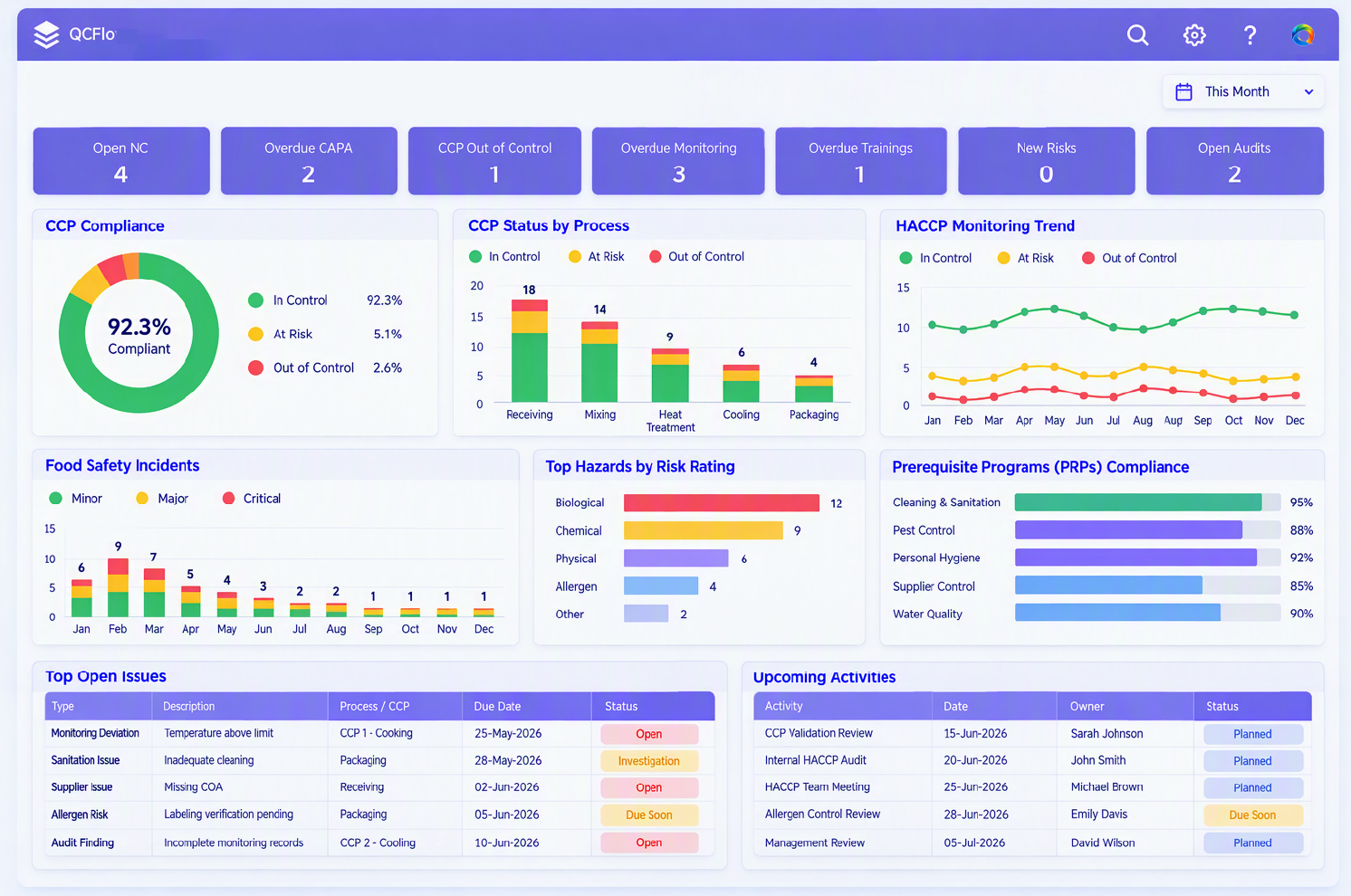
QCFlo helps food industry organizations manage procedures, inspections, nonconformances, corrective actions, and training records through a centralized digital platform. The following compliance mapping highlights how QCFlo supports HACCP-related processes.
| HACCP Requirement (Codex Alimentarius 12 Steps / 7 Principles) | QCFlow Feature Mapping |
|---|---|
| Step 1 - Assemble the HACCP team: form a multidisciplinary team with the knowledge and expertise to develop an effective HACCP plan. | Team/Role master and Department/Employee master can assign HACCP team members, roles (team leader, food safety, production, QA, engineering) and responsibilities. Document Library maintains the approved team charter/appointment record. |
| Step 2 - Describe the product: document product composition, physical/chemical characteristics, packaging, shelf life, storage and method of distribution. | Product Master / Specification record captures composition, characteristics, packaging type, shelf life, storage conditions and distribution method, controlled through Document Library with version history and approval. |
| Step 3 - Identify intended use: define intended use and expected handling of the product by the end user, including vulnerable consumer groups. | Product Master captures intended use, target consumer group and reasonably foreseeable misuse fields; linked to labeling and Document Library-controlled specification records. |
| Step 4 - Construct a flow diagram: develop a process flow diagram covering all steps from raw material receipt to distribution. | Process Management / Process Map list documents each process step, inputs, outputs and sequence; diagrams can be attached and version-controlled in Document Library for HACCP plan reference. |
| Step 5 - On-site confirmation of flow diagram: verify the flow diagram against actual operations during all shifts. | Audit Management / Inspection checklist can record on-site verification of the process flow diagram, discrepancies found, corrective updates and sign-off by the HACCP team. |
| Step 6 (Principle 1) - Conduct a hazard analysis: identify biological, chemical and physical hazards at each step and assess likelihood/severity. | Hazard Analysis Register captures process step, hazard type (biological/chemical/physical/allergen), hazard description, likelihood, severity, risk score and justification, linked to the process flow step. |
| Step 7 (Principle 2) - Determine Critical Control Points (CCPs): identify steps where control is essential to prevent, eliminate or reduce a hazard to an acceptable level. | HACCP/CCP Register (decision-tree based) records process step, hazard addressed, CCP determination, justification and linked hazard-analysis reference. |
| Step 8 (Principle 3) - Establish critical limits: define measurable critical limits (time, temperature, pH, water activity, visual criteria, etc.) for each CCP. | CCP Register captures critical limit parameter, target value, minimum/maximum threshold, validation reference and regulatory/scientific basis for each CCP. |
| Step 9 (Principle 4) - Establish a monitoring system: define how, when and by whom each CCP will be monitored to ensure it remains under control. | CCP Monitoring Log captures CCP reference, monitoring parameter, frequency, method, reading/result, monitored-by, date/time and in-control status, linked to Equipment Management for calibrated instruments. |
| Step 10 (Principle 5) - Establish corrective actions: define actions to be taken when monitoring indicates a CCP is not under control. | NC and CAPA modules capture the deviation, immediate correction, product disposition, root cause, corrective action, owner, due date and effectiveness verification when a CCP monitoring result is out of limit. |
| Step 11 (Principle 6) - Establish verification procedures: confirm the HACCP system is working effectively through validation, calibration, testing and audits. | Audit Management supports HACCP plan verification audits, checklist execution, findings and closure. Equipment Management tracks calibration of monitoring instruments. Validation Master Register supports scientific/technical validation of critical limits. |
| Step 12 (Principle 7) - Establish documentation and record-keeping: maintain records for hazard analysis, CCP monitoring, deviations, corrective actions and verification. | Document Library maintains the HACCP plan, hazard analysis, decision-tree and SOPs with version control. CCP Monitoring Log, NC/CAPA and Audit Management collectively retain full monitoring, deviation and verification records with traceability. |
| Prerequisite Programs (PRPs): GMP, sanitation, pest control, personnel hygiene and supplier control must support the HACCP system. | Cleaning & Sanitation list, Pest Control log, Training & Competence (hygiene category) and Supplier Qualification list provide the prerequisite-programme evidence that underpins CCP control. Audit checklist verifies PRP compliance. |
| Allergen Management: identify, control and label allergens to prevent cross-contact and undeclared allergens in finished product. | Allergen Register (linked to Product Master and Raw Material Management) records allergen type, source material, cross-contact risk, control measure and label-verification status; NC/CAPA manages allergen-related deviations. |
| Supplier and Incoming Material Control: raw materials and packaging must be sourced from approved suppliers and verified on receipt. | Supplier Qualification list captures supplier approval status, audit history and certification; Raw Material Management records COA verification, quarantine/release status and batch traceability at receipt. |
| Traceability and Recall: maintain one-step-back/one-step-forward traceability and an effective recall/withdrawal procedure. | Batch/Lot traceability across Raw Material Management and Batch Manufacturing Record links incoming materials to finished batches and distribution. Product Recall module tracks affected batches, notifications, recovery quantities, effectiveness check and closure. |
| Training and Competence: personnel involved in CCP monitoring and food safety must be trained and competent. | Training & Competence module tracks HACCP/food-safety training plans, attendance, evaluation, competency level and re-training, linked to personnel performing CCP monitoring and PRP activities. |
| Management Review and Continual Improvement: periodically review the HACCP system for suitability, adequacy and effectiveness, and update as needed. | Management Review module compiles verification audit results, CCP deviations, CAPA trends, customer complaints and regulatory changes into review agenda, decisions and follow-up actions. Change Control manages HACCP plan updates triggered by process, recipe or regulatory change. |
Effective HACCP implementation depends on hazard control, consistent monitoring, documented procedures, and prompt action when control measures fail. QCFlo helps organizations organize these activities, maintain supporting records, and improve visibility into food safety processes.
Request a personalized product walkthrough to explore how QCFlo can support your HACCP-related food safety management activities.