FSSC 22000 Compliance Management with QCFlo
FSSC 22000 is a food safety certification scheme that combines ISO 22000 requirements with sector-specific prerequisite programs and additional requirements. It helps food manufacturers and related organizations establish systematic controls to manage food safety risks and meet applicable certification expectations.
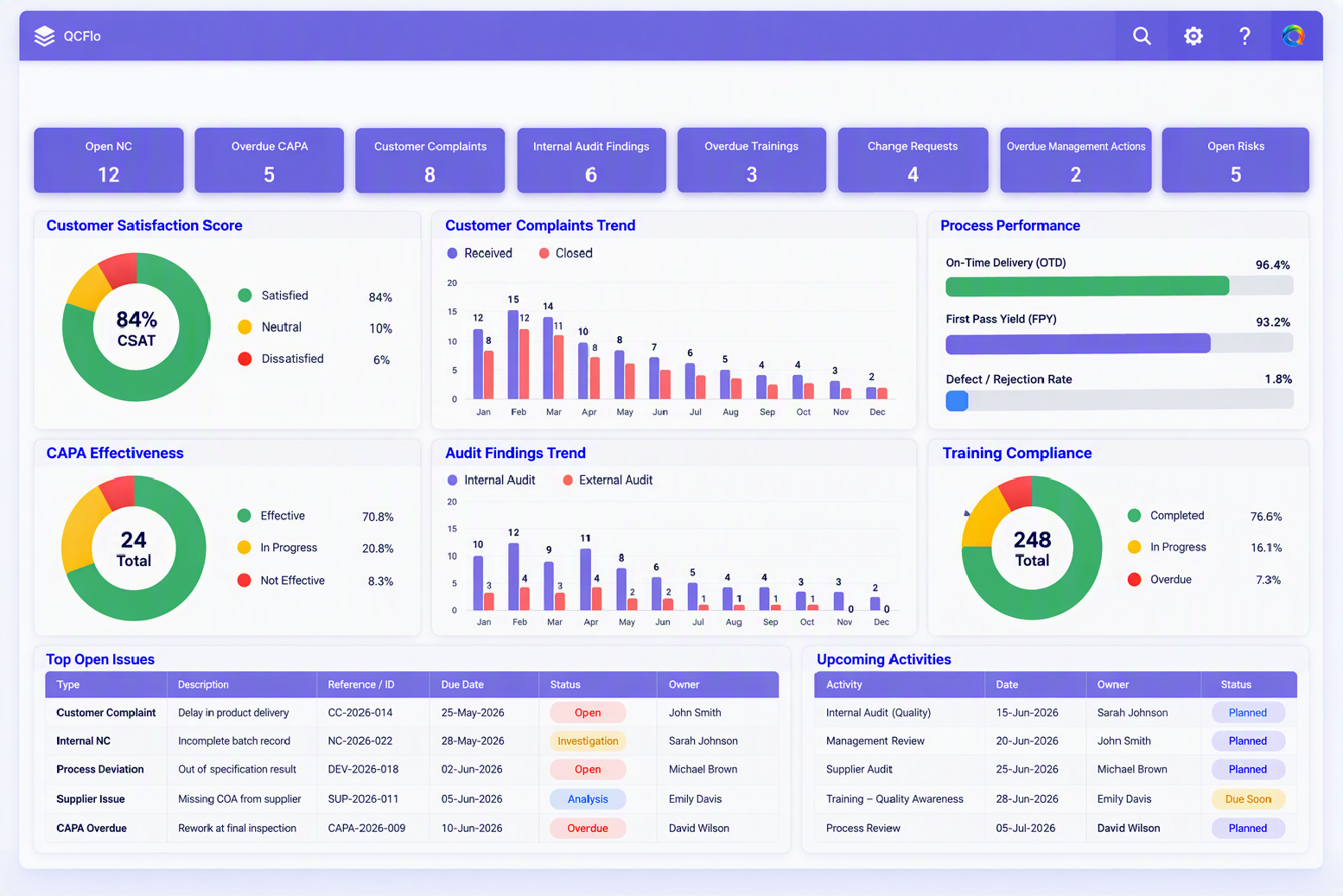
QCFlo helps organizations centralize food safety documentation, manage audits, track nonconformances, coordinate corrective actions, and maintain employee training records. The following compliance mapping highlights how QCFlo supports relevant FSSC 22000 requirements.
| FSSC 22000 Additional Requirement (Scheme Part 2, supplemental to ISO 22000 + ISO/TS 22002 PRPs) | QCFlow Feature Mapping (Gap Flagged Where Applicable) |
|---|---|
| 2.5.1 Management of purchased materials, products and services: verify purchased raw materials, packaging, services and outsourced processes meet food-safety requirements. | Supplier Qualification list + Raw Material Management cover supplier approval, COA verification, quarantine/release status. GAP: no dedicated Outsourced Process/Service Provider Register (e.g., pest control contractor, transport, lab) distinct from material suppliers - recommend adding one. |
| 2.5.2 Product labelling: ensure labels are legible, durable, compliant with regulatory/customer requirements and correctly applied. | Product Master/Specification record can store approved label content and version via Document Library. |
| 2.5.3 Food defense: conduct a threat assessment (TACCP) and implement mitigation plans to prevent intentional contamination/adulteration. | GAP: No Food Defense / TACCP Register exists in the system. Recommend a new register capturing vulnerability assessment, threat, likelihood, mitigation control, access-control measures, owner and review date. Incident Management/NC can record confirmed food-defense breaches once identified. |
| 2.5.4 Food fraud mitigation: conduct a vulnerability assessment (VACCP) and implement a fraud-mitigation plan for raw materials and ingredients. | GAP: No Food Fraud / VACCP Register exists. Recommend a new register capturing raw material, fraud vulnerability type (substitution, dilution, mislabeling), likelihood, economically-motivated-adulteration history, mitigation measure, owner and review. Supplier Qualification supports supplier-side verification only, not fraud-specific scoring. |
| 2.5.5 Logo/mark of conformity: control use of the certification body's or scheme's logo/mark on products, documents and marketing. | Document Library can control approved logo-use guidance as a controlled document. GAP: no dedicated Logo/Mark Usage Approval log linking each use instance to authorization - recommend adding a simple approval log if logo use is frequent. |
| 2.5.6 Management of allergens: assess allergen risk across raw materials, processing and labelling, and control cross-contact. | Allergen Register (linked to Product Master and Raw Material Management) captures allergen type, source material, cross-contact risk, control measure and label-verification status, consistent with the HACCP sheet mapping. NC/CAPA manages allergen-related deviations. |
| 2.5.7 Environmental monitoring: implement a program to detect pathogens/spoilage organisms in the processing environment where applicable. | GAP: No Environmental Monitoring Program register exists. Recommend a new register capturing sampling location/zone, pathogen/indicator organism tested, sample date, lab result, trend, corrective action and verification, linked to NC/CAPA on out-of-limit results. |
| 2.5.8 Formulation of products/food safety and quality requirements for special categories (e.g., nutrition, feed, packaging): ensure formulation meets applicable food-safety and regulatory requirements for the certified product category. | Product Master/Specification record and Document Library-controlled formulation records support this. Regulatory requirement fields can be added to Product Master where category-specific rules apply. |
| 2.5.9 Transport, storage and warehousing: control conditions (temperature, hygiene, pest, segregation) during storage and transport to prevent contamination. | GAP: No Warehouse/Transport Condition Monitoring Register exists. Recommend a new register capturing location/vehicle, temperature/humidity reading, hygiene check, segregation verification, pest-control cross-reference, date/time and responsible person. Cleaning & Sanitation and Pest Control logs partially support this for fixed storage areas. |
| 2.5.10 Requirements for organizations providing services (e.g., transport, storage, cleaning as a subcontracted activity): additional scope-specific requirements for service-providing sites. | Supplier Qualification list and Customer Requirement list can capture service-level requirements and customer contracts. GAP: no scope-specific Service Provider Compliance Checklist distinguishing service-only sites from manufacturing sites - recommend adding one if certifying a service-scope site. |
| 2.5.11 Communication requirements: notify certification body of significant changes that may affect the ability to meet FSMS requirements (e.g., ownership change, recall, regulatory action). | GAP: No Certification Body Notification Log exists. Recommend a new register capturing trigger event (recall, regulatory action, ownership/site change, extended production stoppage), date, notification sent, CB acknowledgement and follow-up status. |
| 2.5.12 Food safety and quality culture: establish, implement and maintain plans to develop and improve food safety and quality culture across the organization. | Training & Competence (culture/awareness category) and Management Review can track culture-building activities, communication and leadership engagement. GAP: no dedicated Food Safety Culture Maturity/Survey Register to score and trend culture assessment results over time - recommend adding one if formal culture surveys are conducted. |
| ISO/TS 22002-x Prerequisite Programmes (PRPs): construction/layout of buildings, layout of premises, utilities, waste management, equipment suitability/cleanability, purchased material management, cross-contamination prevention, cleaning/sanitation, pest control, personnel hygiene facilities. | PRP Register (as flagged in the ISO 22000 sheet) should cover each PRP element with SOP link, owner, frequency, checklist and verification status. Cleaning & Sanitation list, Pest Control log and Training & Competence (hygiene category) provide supporting evidence already in the system; the remaining PRP elements (premises layout, utilities, waste management, equipment cleanability) are best tracked as PRP Register line items rather than separate modules. |
| Mock recall and traceability test: conduct at least annual mock recall/traceability exercises and evaluate effectiveness. | Product Recall module (as used in the HACCP sheet) can log a mock-recall exercise as a test-type record capturing affected batch, trace time, quantity reconciliation, effectiveness result and corrective actions if the exercise reveals gaps. |
| Food safety plan validation and re-validation: re-validate the hazard analysis/HACCP plan when process, product, regulatory or scientific changes occur. | Change Control triggers re-validation of the Hazard Analysis/HACCP Register (as in the ISO 22000 and HACCP sheets) whenever a triggering change occurs; validation evidence is stored via Document Library / Validation Master Register. |
Maintaining an effective FSSC 22000 food safety management system requires documented controls, consistent process oversight, and systematic resolution of identified issues. QCFlo helps organizations coordinate these activities, maintain essential records, and strengthen visibility across their quality and food safety operations.
Request a personalized product walkthrough to explore how QCFlo can support your food safety management processes and FSSC 22000 compliance efforts.